

At their meeting in Wismar on June 1 and 2, 2023, the foreign ministers of the Council of the Baltic Sea States agreed on closer cooperation in the salvage and disposal of munitions from the world wars that are stored on the seabed. German Foreign Minister Annalena Baerbock wants investors in the construction of offshore wind farms in the Baltic Sea to participate in the salvage of munitions waste in the future. In the final declaration, the council members point out the dangers that conventional and chemical munitions pose to the marine environment, fisheries, shipping and renewable energy plants. According to estimates by the Fraunhofer Institute, there are up to 400,000 tons of conventional munitions and about 40,000 tons of chemical warfare agents in the Baltic Sea. The Institute for Toxicology and Pharmacology for Natural Scientists of the University Hospital Schleswig-Holstein under the direction of Prof. Dr. Edmund Maser provided essential insights into the environmental hazards of these toxic explosives in more than 10 years of research work. After a short lecture by Dr. Jennifer Strehse in Wismar, Dr. Strehse and Prof. Maser were available to answer the foreign ministers' questions.
Edmund Maser, UKSH
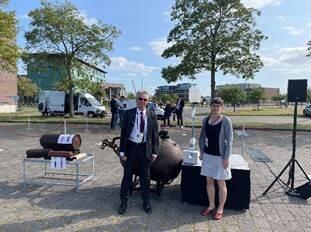
left: Dr. Jennifer Strehse and Prof. Edmund Maser in front of exhibits of rusting World War II ammunition. (pic: E. Maser)
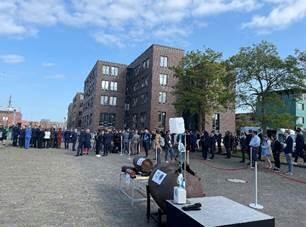
middle: The 25 foreign ministers of the Council of the Baltic Sea States and their delegation are welcomed by the Prime Minister of Mecklenburg-Western Pomerania Manuela Schwesig. (pic: E. Maser)
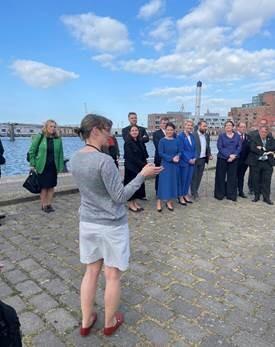
right: Dr. Jennifer Strehse during her presentation on the dangers of dumped World War II munitions to the foreign ministers of the Baltic Sea states. (pic: E. Maser)