

The Alkor expedition (AL642) took place from 14 to 29 October 2025. As part of three research projects, AL642 is investigating dumped marine munition: CONMAR-II, MuniRisk (addresses the problem of marine munition and its risk assessment at a stakeholder level in the European Baltic Sea region) and MMinE-SwEEPER (the largest of the three projects), which involves technical developments in the field of munitions detection and robotics, as well as knowledge transfer, stakeholder activities and the design of a European solution. During the first leg of the expedition, the team investigated a dumping area for chemical munitions northeast of Bornholm. A significant portion of the officially designated dumping area was mapped during one short (two-hour) and two long (20-hour) dives with the AUV 'Abyss', as well as two shorter missions with the AUV 'Albert'. As the seabed here consists of homogeneous soft sediment, hard contacts could be clearly identified in the backscatter data. Individual hard contacts are visible throughout the mapped area, and ROV dives have revealed that these are bombs, some of which are heavily corroded. Often, only the tail fins of 250 kg bombs are visible, along with yellowish/orange chunks of encapsulated warfare agents such as mustard gas. But isn't mustard gas dangerous? No, not anymore, once is in waters it hydrolyses very quickly (half-life of 15 minutes) into non-toxic substances, so simply looking at it poses is not dangerous. After four successful days, however, the ALKOR had to seek shelter in Rønne on Bornholm, as strong north-westerly winds would have made it impossible to work with AUVs and ROVs in the work area. Then it was time to move on. The AUV 'Abyss' was deployed for another 20-hour overnight dive. Additionally, a CTD grid was sampled across the entire Bornholm Basin to evaluate potential contamination with TNT and other explosives. Then the AUV 'Luise' was deployed. 'Luise' explored clusters of bombs using photogrammetry. At the same time, magnetic surveys were carried out to determine whether larger munitions were buried in the sediment. An initial viewing of the photos shows heavily corroded munitions. These images are currently being processed into a photomosaic and a DTM (digital terrain model). On the way back, there was a brief stop at the Nord Stream 1 pipeline blast site. The aim was to document the environmental conditions there three years after the explosion. During the second week, the impact of the pilot clearances carried out in August this year on the marine environment was investigated in Lübeck Bay.
Mareike Keller, GEOMAR
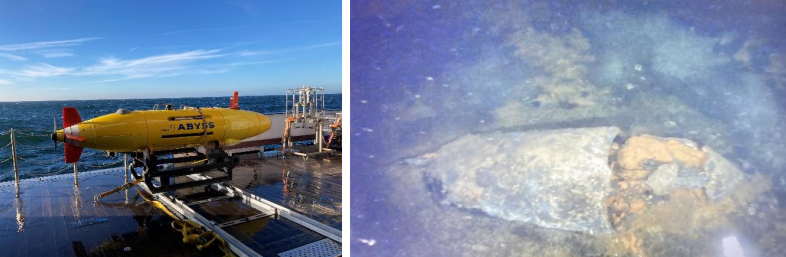
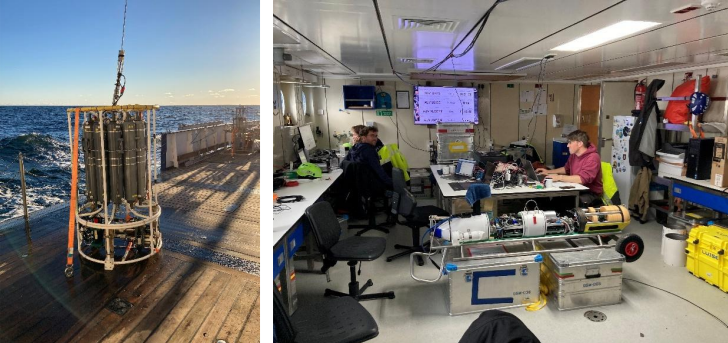
Left: AUV Abyss on the deck of the ALKOR (left) and chemical warfare agent in the Bornholm Basin (right) Right: CTD on the deck of the ALKOR (left) and a view of the dry lab on the ALKOR as the AUV control center (right)